

Understanding the Golden Age of Cyberfraud: 2017–2027
Deepfakes, Real-Time Payments and Moving at the Speed of Fraud
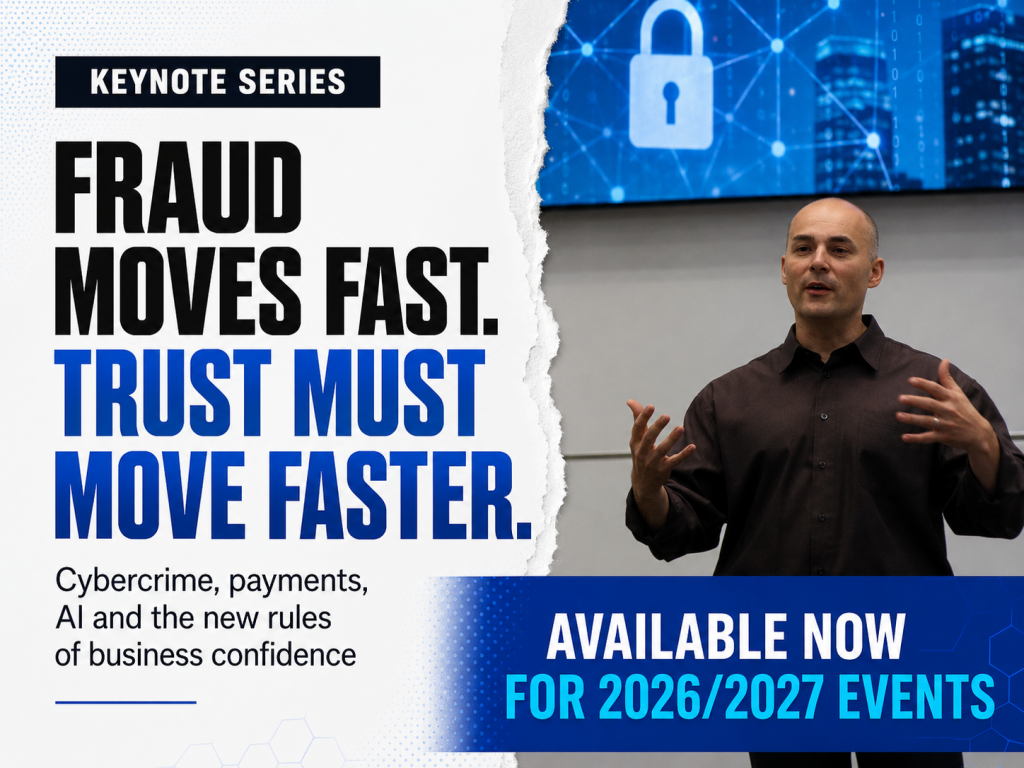
In Understanding the Golden Age of Cyberfraud, Claudiu traces the extraordinary transformation of fraud across one pivotal decade. The stories are sometimes audacious, occasionally absurd and increasingly expensive. Behind them is a serious question for every professional audience: how do you verify people, instructions and transactions when believable evidence can now be manufactured on demand?
Canadians reported more than $704 million in fraud losses in 2025, yet federal agencies estimate that only 5 to 10 per cent of fraud is reported. Reported losses since 2022 have already exceeded $2.4 billion.
South of the border, the FBI received more than one million internet-crime complaints in 2025 representing nearly $21 billion in reported losses. For the first time, the FBI separately tracked AI-related complaints: 22,364 of them, responsible for almost $893 million in losses.
That is how quickly the business model has changed.
The fraudster of a decade ago needed a good script, persistence and a believable email. Today’s criminal can add a cloned voice, synthetic video, forged identity documents, compromised business accounts, automated translation and AI-generated persuasion, then move the money before anyone has time to compare notes.
Canadian regulators reported approximately $154 million in wire-transfer fraud and $36.7 million in Interac e-Transfer fraud in 2024 alone.
Ideal Audiences
banking, finance, insurance, accounting, legal, fintech, payments, boards of trade, chambers of commerce, associations, law enforcement, municipalities and executive audiences.
Audience takeaways
- How fraud evolved from crude deception into an AI-enabled industry
- Why deepfakes and synthetic identities change traditional verification
- How speed changes the economics of payment fraud
- Why intelligent and experienced people remain vulnerable to social engineering
- How organizations can introduce verification without bringing business to a halt
$704 million reported lost to fraud in Canada in 2025, with only 5–10% of fraud believed to be reported.
Promise:
See how fraud learned to move faster than traditional controls, and what organizations need to change before the next transaction leaves the building.
FAQ
Is this talk focused on small businesses or large organizations?
Both. The principles apply to SMEs, professional firms, public institutions and enterprise teams.
Does it cover AI scams and deepfakes?
Yes. Claudiu explains how AI is changing fraud, impersonation and social engineering.
Is this suitable for finance teams?
Yes. It is highly relevant for finance, accounting, procurement, operations and leadership teams.
Will the audience get practical tips?
Yes. The keynote includes practical habits and controls that can reduce fraud risk immediately.
Can this be adapted for public audiences?
Yes. It works well for community events, chambers, associations, municipalities and professional groups.