

The UnHackable Generation
Critical Thinking, AI Literacy and the Fight to Give an Unbroken Internet to the Next Generation
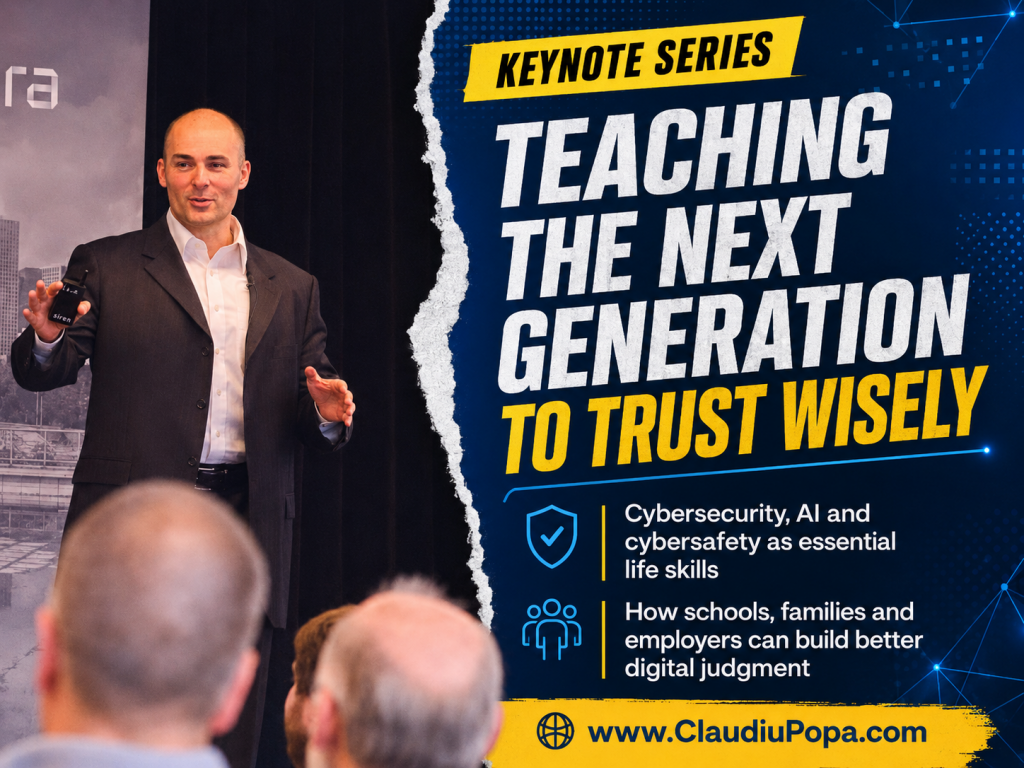
The UnHackable Generation brings together Claudiu’s work in cybersecurity, privacy, education, cyberfraud and the KnowledgeFlow Foundation’s UnHackable program. Through stories, experiments and examples drawn from the way information actually reaches young people, Claudiu explores misinformation, malinformation, disinformation, social engineering, surveillance, privacy, digital identity and AI literacy.
The aim is larger than online safety. It is to give the next generation the critical-thinking skills to understand the Internet they inherited, protect the people around them and recognize when somebody is trying to make a decision for them.
Four out of five Canadians now encounter online information they suspect is false or misleading at least once a month. Nearly half say it has become harder to distinguish true information from false information, and among Canadians under 35, 78 per cent use social media as a primary source of news and information.
A student can now open a phone before school and encounter a genuine news report, a synthetic photograph, a paid influencer, an AI-generated voice, a scam, an algorithmically amplified rumour and a perfectly confident chatbot answer before the first class begins.
Knowing how to operate the device is no longer enough.
Microsoft’s 2026 global online-safety research found that teen exposure to hate speech reached 35 per cent, scams 29 per cent and cyberbullying 23 per cent. Across all respondents, 91 per cent said they worry about harms introduced by AI.
Ideal Audiences
schools, colleges, universities, teachers, education leaders, parents, libraries, youth organizations, municipalities, nonprofits, community groups, workforce-development programs and digital-literacy conferences.
Audience takeaways
- How to test the credibility of information before repeating or acting on it
- How misinformation, malinformation and disinformation work differently
- Why AI literacy requires skepticism as well as technical skill
- How social engineering turns emotion, authority and urgency into manipulation
- How schools, families and communities can build practical cyber-situational awareness
80% of Canadians encounter suspected misinformation monthly. For Canadians under 35, 78% get news or information through social media.
Promise:
Help young people become capable participants in the Internet rather than passive targets of whatever reaches their screens.
FAQ
Is this keynote political?
It is civic, not partisan. The focus is privacy, cybersafety, human rights, digital resilience and the future of a free Internet.
What does “UnHackable” mean?
It means building the mindset, habits and confidence to resist manipulation, protect privacy and make safer digital decisions.
Is this suitable for students?
Yes. It is especially strong for students, educators, parents, youth leaders and community audiences.
Does it discuss AI and disinformation?
Yes. The keynote covers AI-enabled deception, disinformation, malinformation, surveillance and digital manipulation.
Can this keynote be made more corporate or more activist?
Yes. It can be adapted for schools, universities, privacy events, civic forums, nonprofits, corporate audiences or public-sector programs.
Testimonials
“I just wanted to send you a quick note that tonight’s session was amazing! Claudiu was so great and every parent who attended had nothing but positive things to say on their way out! They were saying everything from “can we schedule another session with Claudiu?” to “can we have him come back to speak with our children?””